

Pharmacy Automation Market to reach USD 17.34 Billion by 2035 at 9.32% CAGR
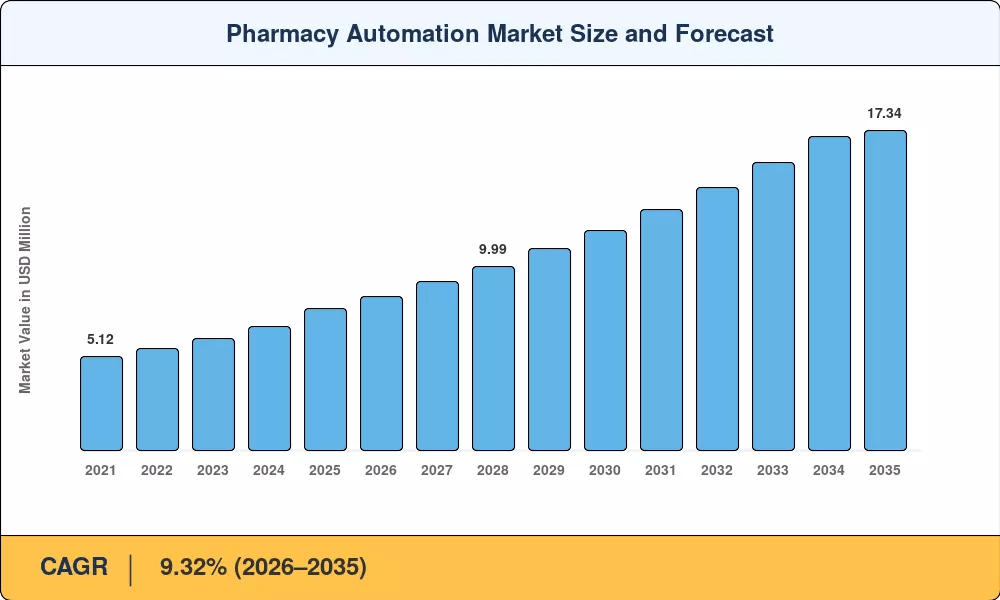
Pharmacy Automation Market Size
Pharmacy Automation Market to Surge from USD 8.36 Bn in 2026 to USD 17.34 Bn by 2035-By Pharmacist Workforce Shortages, FDA Regulatory Compliance Mandates
NY, GA, UNITED STATES, June 12, 2026 /EINPresswire.com/ -- As per Market Research Future, the global Pharmacy Automation Market size to reach USD 17.34 Billion by 2035 from USD 8.36 Billion in 2026, at a CAGR of 9.32% during the forecast period 2026--2035. The market base was estimated at USD 7.69 Billion in 2025.The 9.32% CAGR---anchored by structural operational demand rather than discretionary healthcare spending---is driven by three converging forces: persistent pharmacist workforce shortages across OECD nations that continue to widen the addressable base for medication management systems, sustained regulatory mandates exemplified by the FDA's 2024 liability guidance for machine-dispensed medications that has converted automated drug dispensing from a convenience upgrade into an operational mandate, and the technological shift from legacy manual dispensing workflows toward integrated pharmacy workflow automation platforms that combine robotic prescription filling with cloud-hosted inventory engines and real-time barcode medication verification.
National governments and multilateral health organizations are amplifying this momentum. Hospital systems facing 15--20% vacancy rates in pharmacy staff are accelerating capital reallocation toward robotic prescription filling and medication management systems that absorb repetitive tasks without compromising patient safety. The EU Falsified Medicines Directive requires end-to-end serialization and barcode medication verification for every dispensed unit, converting manual methods into compliance liabilities.
Cloud-hosted inventory engines now deliver real-time visibility across multi-site health networks, reducing stock-outs by as much as 38% and trimming expired-drug write-offs that previously cost mid-size hospitals upward of USD 230,000 annually. Amazon Pharmacy and Mark Cuban Cost Plus Drug Company have demonstrated that high-throughput fulfillment hubs---processing over 10,000 prescriptions per hour with near-zero human touchpoints---set the competitive bar that traditional mail-order operators must meet through barcode medication verification and robotics investment. Together, these initiatives are creating the procurement infrastructure and delivery innovation on which the Pharmacy Automation Market depends.
Request A Free Sample:
https://www.marketresearchfuture.com/sample_request/8775
Key Market Trends & Growth Drivers
Pharmacist Workforce Shortages and Hospital System Demand
Pharmacy staffing schedules increasingly face structural deficits, with a 17% decline in pharmacy school applications between 2019 and 2024 compounding a staffing gap that estimates will leave 21,000 pharmacist positions unfilled across the US by 2028.
Hospital systems responding to this pressure are deploying automated drug dispensing cabinets and robotic prescription filling lines to maintain throughput without proportional headcount increases. Institutions with pharmacy workflow automation reduced overtime costs by 32% within 18 months of deployment. Each percentage point of vacancy rate gain translates into measurable procurement volume for medication management systems, and the pharmacy automation schedule embedded in routine hospital operations makes this driver structurally durable through 2035.
Regulatory Compliance Mandates and Barcode Medication Verification
Regulatory frameworks increasingly require strict software validation and data integrity controls for computerized systems, with the FDA's 2024 liability guidance for machine-dispensed medications converting automated drug dispensing from a convenience upgrade into an operational mandate. Under frameworks like 21 CFR Part 11, state boards of pharmacy and federal regulatory agencies are placing an increasing emphasis on secure electronic signatures and unchangeable audit trails.
Automated medicine dispensing systems must retain these controls to reduce systemic operational risk. Every prescription unit in Europe must have end-to-end barcode medication verification to comply with the Falsified Medicines Directive's serialization requirements, which manual methods are unable to consistently meet on a large scale.
Pooled procurement through group purchasing organizations drives per-unit prices down for high-volume medication management systems, expanding access while compressing manufacturer margins. The EU Falsified Medicines Directive requires end-to-end serialization and barcode medication verification for every dispensed unit, creating a compliance-driven adoption wave that traditional manual dispensing cannot satisfy.
Cloud-Hosted Inventory Platforms and ePharmacy Competitive Pressure
Legacy manual dispensing workflows, once the backbone of community and hospital pharmacies, are giving way to integrated pharmacy workflow automation platforms. Cloud-hosted inventory engines now deliver real-time visibility across multi-site health networks, reducing stock-outs by as much as 38% and trimming expired-drug write-offs that previously cost mid-size hospitals upward of USD 230,000 annually.
Multi-site health systems with more than 50 pharmacy sites are adopting cloud-based inventory engines that combine demand signals in real time and allow for the automated redistribution of near-expiry stock among facilities. Large-scale hospital groups have been able to decrease annual capital waste from expired-drug write-offs and significantly reduce medicine stock-outs thanks to centralized pharmacy workflow automation networks.
Amazon Pharmacy's fulfillment model---processing more than 10,000 prescriptions hourly through robotic prescription filling lines with minimal human intervention---has established a throughput benchmark that traditional pharmacy operators cannot match manually. Mark Cuban Cost Plus Drug Company and PillPack have amplified this competitive dynamic, forcing retail pharmacy chains to invest in automated drug dispensing infrastructure to defend market share.
Ask for Customization:
https://www.marketresearchfuture.com/ask_for_customize/8775
Market Segment Insights
BY PRODUCT
Automated Medication Dispensing Systems: Dominant segment with ~51.2% revenue share in 2025. Reflecting their entrenched role across acute-care settings. Installed in over 85% of US acute-care facilities and increasingly adopted across European hospital trusts under EU barcode medication verification mandates. These systems integrate with medication management systems to provide closed-loop verification from physician order entry through bedside administration, reducing wrong-patient dispensing events by up to 86% in documented implementations. Pyxis and XT Series anchor this segment.
Robotic Sterile Compounding Systems: Fastest-growing product category at 11.28% CAGR (2026--2035). Driven by USP <797> and <800> compliance pressure and demand for IV admixture accuracy. A single robotic compounder can prepare 60--80 IV admixtures per hour with gravimetric accuracy verification, a throughput level that would require three to four manual compounding technicians. The Pharmacy Automation Market is seeing particular demand for these systems from oncology centers and large academic medical centers with high volumes of hazardous drug preparation.
BY END USER
Hospital Pharmacies: Dominant application with ~66.8% share in 2025. Driven by medication error reduction mandates and formulary complexity. Hospital pharmacies represent the largest end-user segment, where automated drug dispensing cabinets serve as the operational backbone for inpatient medication distribution. The complexity of hospital formularies---averaging 2,500--4,000 unique line items in academic medical centers---demands pharmacy workflow automation capable of managing par levels, expiry rotation, and controlled substance chain-of-custody documentation simultaneously.
Mail-Order & ePharmacies: Fastest-growing end-user segment at 12.37% CAGR (2026--2035). Direct-to-consumer fulfillment models scale robotic prescription filling capacity. Amazon Pharmacy's fulfillment model---processing more than 10,000 prescriptions hourly through robotic prescription filling lines with minimal human intervention---has established a throughput benchmark that traditional pharmacy operators cannot match manually. These operations rely on high-speed robotic prescription-filling lines capable of processing thousands of prescriptions per hour with barcode medication verification at each handling step.
BY DEPLOYMENT MODEL
Centralized Automation Hubs: Dominant deployment model with ~62.7% share in 2025. Economies of scale in multi-site health systems drive demand for centralized robotic prescription filling and automated drug dispensing.
Decentralized Point-of-Care Units: Fastest-growing deployment model at 11.42% CAGR (2026--2035). Bedside dispensing, OR, and ICU medication access drive demand for point-of-care automated drug dispensing cabinets.
BY FACILITY SIZE
Large Facilities (>500 Beds / >250 Retail Outlets): Dominant segment with ~59.2% share in 2025. Scale-driven ROI and enterprise procurement agreements favor large-scale pharmacy workflow automation deployments.
Mid-Size Facilities (200--500 Beds / 50--250 Outlets): Fastest-growing facility segment at 9.88% CAGR (2026--2035). PAaaS adoption and mid-market competitive pressure drive demand. Pharmacy-Automation-as-a-Service models convert capital expenditures into operating expenditures.
Small Facilities (<200 Beds / <50 Outlets / Independents): Growing segment at 11.62% CAGR (2026--2035). Subscription models and entry-level medication management systems lower barriers for independent operators.
Read Detailed Insights:
https://www.marketresearchfuture.com/reports/pharmacy-automation-market-8775
Regional Outlook
North America -- Dominant Market (~44.5% Share, 2025)
The United States generates approximately 78.3% of North American Pharmacy Automation Market revenue, driven by Medicare quality-reporting incentives and widespread 340B drug pricing program participation---a single policy ecosystem that converted a manual-dispensing-dominated market into one with a structural automation tail. Automated drug dispensing cabinet penetration exceeds 85% in acute-care hospitals with over 300 beds. CMS's Hospital Quality Reporting Program now ties reimbursement adjustments to medication error rates, making pharmacy workflow automation a direct revenue-protection measure. The US dominates through a combination of pharmacist workforce shortages, FDA regulatory compliance mandates, and ePharmacy competitive pressure.
Canada contributes through provincial drug plan automation mandates at 9.64% CAGR, while Mexico is growing at steady pace on IMSS hospital modernization program at USD 0.18 Billion in 2025. North America's leadership rests on reimbursement depth and the structural automation segment created by expanded quality reporting mandates and 340B drug pricing program participation.
Europe -- Second Largest (USD 1.92 Billion, 2025)
Europe's Pharmacy Automation Market reflects divergent national strategies---Germany leads regionally with its Krankenhauszukunftsgesetz hospital digitization fund allocating EUR 4.3 billion for hospital digitization with pharmacy automation explicitly eligible, contributing ~24.6% of regional share, while the UK historically used selective pharmacy targeting before broadening coverage through the NHS Pharmacy Integration Programme deploying automated drug dispensing systems across 200+ hospital trusts by 2027. France contributes USD 0.29 Billion through Ségur du Numérique en Santé funding. Italy is growing at 8.92% CAGR on PNRR healthcare digitization allocation.
Asia-Pacific -- Fastest-Growing Region (10.35% CAGR, 2026--2035)
Asia-Pacific is the engine of the Pharmacy Automation Market. China holds the largest regional share with ~34.2% of regional revenue, driven by the 14th Five-Year Plan hospital informatization---pharmacy automation installations grew 34% year-over-year in 2024 as tier-2 and tier-3 city hospitals adopted centralized robotic prescription filling to manage rising outpatient volumes. India is growing at 11.52% CAGR on the back of Ayushman Bharat Digital Mission funding automated drug dispensing pilots across 150 district hospitals. Japan contributes USD 0.31 Billion through super-aging society workforce automation at steady pace.
Middle East & Africa -- Emerging Opportunity (8.74% CAGR, 2026--2035)
The Middle East & Africa carries the widest infrastructure gap and therefore the steepest opportunity. Saudi Arabia leads the region with Vision 2030 smart hospital program, contributing ~31.8% of regional share---NEOM and King Faisal Specialist Hospital deploying fully automated drug dispensing and compounding systems. The UAE is growing at 9.42% CAGR on Dubai Health Authority mandatory automation standards in all licensed hospital pharmacies effective 2025. South Africa contributes USD 0.04 Billion on NHI pharmacy centralization.
South America -- Growing Presence (USD 0.34 Billion, 2025)
Brazil anchors South America's Pharmacy Automation Market at ~62.4% of regional revenue, with the SUS system---the Ministry of Health earmarking BRL 1.2 billion for hospital pharmacy modernization through 2028---providing a stable demand floor that smooths regional forecasts. Centralized automated drug dispensing hubs are being deployed in São Paulo and Rio de Janeiro's largest public hospitals, targeting a 40% reduction in dispensing errors. Argentina is growing at 8.56% CAGR on PAMI pharmacy automation procurement for its network serving 5 million beneficiaries.
Competitive Landscape and Recent Developments
The Pharmacy Automation Market is moderately concentrated, with an estimated Herfindahl-Hirschman Index in the 850--1,050 range and the top five suppliers holding roughly 48--55% of global revenue. Concentration is highest in high-income segments where regulatory and manufacturing barriers are steep; the emerging-market tier is more fragmented as regional producers compete on price.
The competitive landscape is stratified between premium platform providers serving hospital and retail markets, high-volume logistics automation suppliers capturing multi-site health system tenders, and compounding specialists consolidating the sterile preparation segment.
KEY COMPANIES AND RECENT MILESTONES
BD (Becton, Dickinson and Company) (2023--2025): Maintains leadership with Pyxis automated dispensing cabinets and Parata robotic filling, commanding ~12--16% of global Pharmacy Automation Market revenue. Full-spectrum hospital and retail automation leader. Premium platform positioning in acute-care settings offsets tender-price compression in pooled procurement.
Omnicell (January 2025): Expanded its Pharmacy-Automation-as-a-Service program to cover 340B-eligible facilities, bundling XT Series hardware with EnlivenHealth adherence analytics. Cloud-first platform with SaaS analytics layer anchors a strong North America franchise, holding ~10--14% of global revenue. The company benefits from the structural hospital automation tail created by expanded quality reporting mandates.
Baxter International (2024--2025): Maintains DoseEdge pharmacy workflow management and IV compounding portfolio, commanding ~7--10% of global revenue. IV and compounding automation specialist serving oncology centers and academic medical centers globally.
Swisslog Healthcare (KUKA) (July 2024): Signed a five-year agreement with NHS England to deploy PillPick automated dispensing and barcode medication verification across 85 hospital trusts. European logistics automation with robotic integration anchors a strong regional franchise, holding ~5--8% of global revenue.
McKesson Corporation (2024--2025): Maintains pharmacy management software and distribution automation portfolio, commanding ~5--7% of global revenue. Distribution-centric automation with supply chain integration serves North American retail and hospital networks.
Future Outlook: 2026--2035
By 2030, autonomous pharmacy operations will become the operating system of medication dispensing. Fully autonomous pharmacy micro-fulfillment centers---combining robotic prescription filling, AI-driven clinical decision support, and automated drug dispensing---will handle an estimated 25% of outpatient prescription volume in the US. These facilities will operate with pharmacist oversight ratios of 1:5,000 prescriptions per shift, compared to the current 1:150 in staffed pharmacies. The Pharmacy Automation Market will increasingly stratify between high-volume autonomous hubs and specialized compounding centers requiring human expertise. Machine learning algorithms trained on prescription history, epidemiological data, and formulary changes can pre-stage medications in automated drug dispensing cabinets before demand spikes materialize, with early adopters reporting a 28% improvement in first-fill rates and a 19% reduction in pharmacist intervention time.
Platform economics and interoperability will reframe cost structures by the early 2030s. The shift toward open-API pharmacy workflow automation platforms will enable health systems to compose best-of-breed technology stacks rather than purchasing monolithic solutions from single vendors. HL7 FHIR R5 adoption, expected to reach 60% of US hospital pharmacies by 2028, will unlock plug-and-play integration between automated drug dispensing cabinets, EHR systems, and supply chain platforms. This interoperability layer will accelerate medication management systems deployment in smaller facilities previously deterred by integration complexity. As per-device costs fall with scale, the addressable channel widens from large hospitals to mid-size facilities and retail pharmacies.
More Related Research Insights:
https://www.marketresearchfuture.com/reports/automated-dispensing-machines-market-6631
https://www.marketresearchfuture.com/reports/pharmacy-market-12003
https://www.marketresearchfuture.com/reports/medical-automation-market-5184
https://www.marketresearchfuture.com/reports/medication-management-market-7187
https://www.marketresearchfuture.com/reports/pharmacy-management-system-market-8563
https://www.marketresearchfuture.com/reports/medical-robotics-market-1311
https://www.marketresearchfuture.com/reports/laboratory-automation-market-11830
https://www.marketresearchfuture.com/reports/healthcare-it-market-5950
https://www.marketresearchfuture.com/reports/drug-delivery-devices-market-11841
https://www.marketresearchfuture.com/reports/smart-healthcare-market-12284
Larry Wilson
WantStats Research And Media Pvt. Ltd.
+1 855-661-4441
email us here
Visit us on social media:
LinkedIn
Facebook
YouTube
X
Legal Disclaimer:
EIN Presswire provides this news content "as is" without warranty of any kind. We do not accept any responsibility or liability for the accuracy, content, images, videos, licenses, completeness, legality, or reliability of the information contained in this article. If you have any complaints or copyright issues related to this article, kindly contact the author above.
